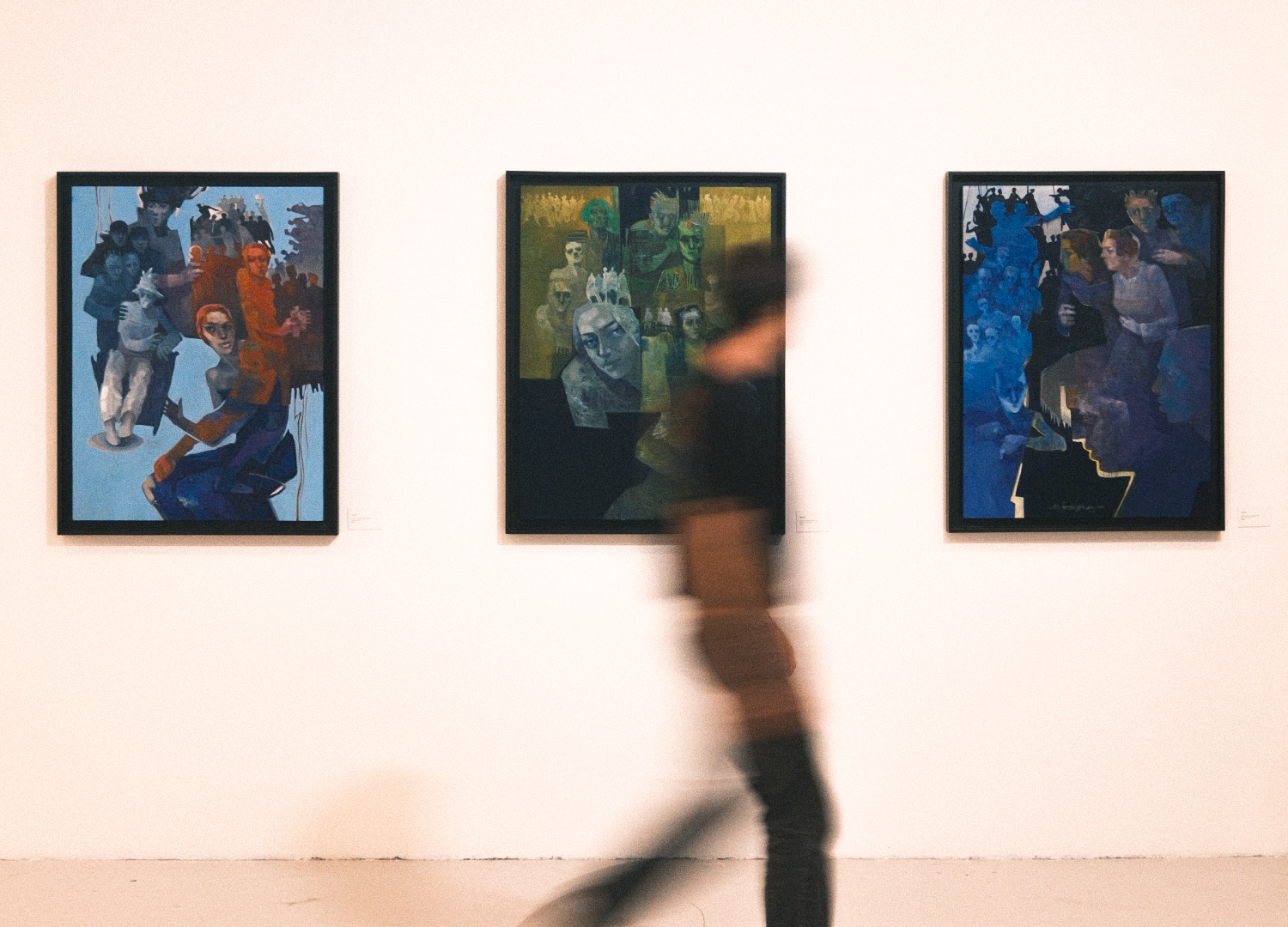
Hüsamettin Koçan was born in 1946 in Baksı village, Bayburt. He graduated from the State School of Applied Fine Arts in 1970 and began his academic career there as a teaching assistant in 1975. From early on, he conducted research on folk painting; the knowledge he developed laid the foundation for the Turkish Folk Paintings Collection now housed at the Baksı Museum. Since the 1970s, Koçan has received more than thirty awards in recognition of his artistic practice, including the Grand Prize at the Asian Art Biennial and the Honour Award of the Grand National Assembly of Türkiye. Between 1990 and 1995, he served as President of the Turkish National Committee of the International Association of Art (IAA). He was also the founder of the Istanbul Art Fair—an initiative that played a significant role in bringing contemporary art to wider audiences—and served as Chair of its Executive Board for four years. In 1994, he participated in the formation of the Artists’ Convention Initiative Committee, established to place artists’ rights on the public agenda, and served as its Chair.
In 1993, he was appointed professor. From 1997 to 2006, Koçan served as Dean of the Faculty of Fine Arts at Marmara University. During his tenure, he led initiatives that enhanced the quality of education and strengthened the faculty’s engagement with society and the wider world, placing the concepts of human, culture, memory, and openness at the core of his administrative vision. Guided by a Bauhaus-inspired understanding of art and design education integrated with life, he initiated the mobile museum project Art-Truck in 1998 and, in 1999, the rehabilitation-oriented Art-Tent project for children and youth in the earthquake region.
Throughout his deanship, he developed a model that connected the university with the city through initiatives such as the panel series “The Dissemination-Popularization of Art,” the event program “Galleries,” and the interactive platform “False Truths-True Falsehoods.” He organized public exhibitions and certified weekend programs, established advisory boards within the departments to strengthen ties between the professional field and academia, and introduced a preparatory year as well as double-major and minor opportunities within the framework of the European Credit Transfer System (ECTS) to enhance students’ international mobility.
Koçan has held more than fifty solo exhibitions to date. In 1990, he presented a retrospective in Ankara titled Hüsamettin Koçan from His Own Collection, bringing together works produced between 1975 and 1990 and making visible his engagement with cultural fragmentation, historical continuity, and the civilizations of Anatolia. The exhibition series Overlapping Times, held in Germany in 1992, became a precursor to the broader project Visual History of Anatolia, conceived as a critical response to official historiography and a reckoning with modernism. Beginning in 1993, through the Visual History of Anatolia fascicles as well as series such as Antipas: Enchanted Hands, Find Me, Fragments of Sorrow, Enchanted Sculptures, Homage to 123+2 Artists, Mystery of the Shaman, Paintings for the Blind, and Fragile Faces / Nine Views, Koçan addressed soil as a space of life and death, a site of memory. His exhibition Find Me (2000) was dedicated to the anonymous cultural spirit of Anatolia and to the lost life of the folk painter Muallim Ahmet Sait. While planning to devote the fourth fascicle of Visual History of Anatolia to Byzantium, he turned toward his native village and initiated the Baksı project.
The Baksı Museum collection was formed through voluntary donations. Construction of the museum began in 2001, with its first section opening in 2004. Following the establishment of the Baksı Foundation for Culture and Arts in 2005, the museum officially opened on 13 July 2010. Recognized for its projects supporting local production and women’s employment, the museum was awarded the European Museum of the Year Award in 2014.
Baksı Museum represents a synthesis of Koçan’s artistic practice, bringing different temporalities into dialogue, and his administrative vision, which conceives education as a formation extending from the school into the wider world. Founded in a geographically and socially eroded region, the museum questions and rejects established cultural hierarchies between art and craft at the core of its collection. Its most distinctive characteristic, however, lies in its sustained commitment to projects that contribute to the economic, social, and cultural life of its surroundings. In this sense, Baksı stands as Koçan’s most comprehensive work, embodying the central motifs of his art: the human being, soil, the hand, labor, anonymity, the shamanic spirit, migration, solitude, loss, and the act of finding oneself.